
Affiliate disclosure: This article contains affiliate links, including links to Reolink and Amazon.ca. As an Amazon Associate, SmartDwellingLab earns from qualifying purchases. If you buy through these links, we may earn a commission at no additional cost to you.
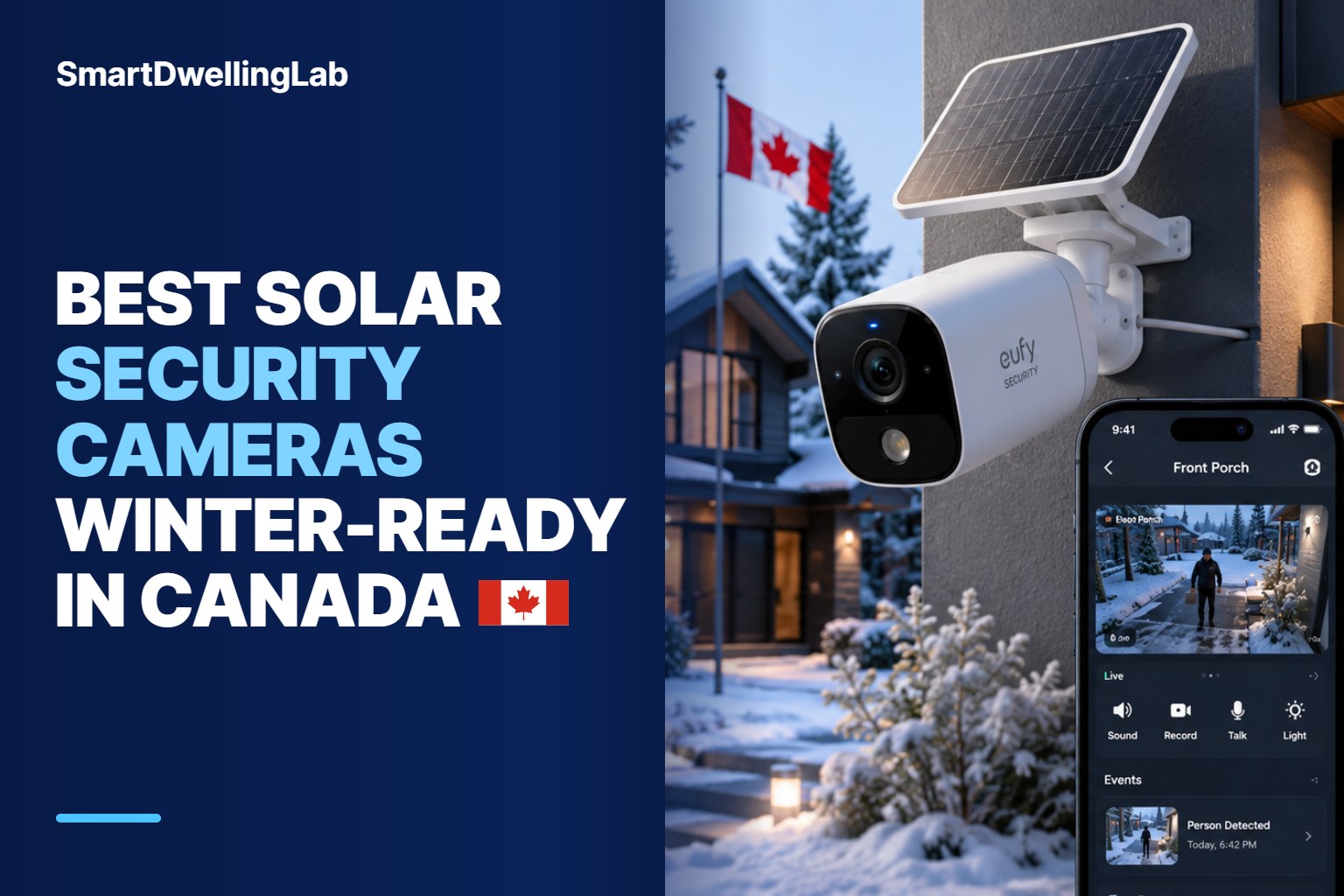
Solar security cameras are a great fit for Canadian properties where running power is difficult—detached garages, sheds, long driveways, farms and cottages. But Canada is a tough test for solar: winter days are short, panels get buried in snow, and most rechargeable batteries won’t charge below freezing. A camera that runs “forever” in a California ad may need a manual recharge in a Winnipeg January.
In this research-based guide, we compare the best solar security cameras available in Canada, with a focus on cold-weather ratings, battery size, local storage and whether you’ll need a subscription.
Quick Picks
- Best overall: eufy SoloCam S340
- Best for Canadian winters: Reolink Altas PT Ultra
- Best all-in-one (built-in panel): Reolink Argus Solar
- Best value: TP-Link Tapo C425 Kit
- Best for cottages without Wi-Fi: Reolink Go PT Ultra (4G LTE)
- Best for Ring users: Ring Spotlight Cam Plus, Solar
Solar Security Camera Comparison
| Camera | Video | Solar setup | Listed operating temp. | Storage / subscription |
|---|---|---|---|---|
| eufy SoloCam S340 | 3K dual-camera, 360° pan & tilt | Removable panel included | -20°C to 50°C | Local storage, no monthly fee |
| Reolink Altas PT Ultra | 4K, pan & tilt | Separate panel (bundle available); 20,000 mAh battery | -20°C to 55°C | microSD, no subscription required |
| Reolink Argus Solar | 5MP | Built-in panel; 6,500 mAh battery | -20°C to 55°C | microSD up to 512GB |
| TP-Link Tapo C425 Kit | 2K, 150° view | Separate panel included | -20°C to 45°C (charges 0°C to 45°C) | microSD up to 512GB; cloud optional |
| Reolink Go PT Ultra | 4K, pan & tilt, 4G LTE | Separate panel (bundle available) | -10°C to 55°C | microSD; cellular data plan needed |
| Ring Spotlight Cam Plus, Solar | 1080p, spotlights + siren | Separate panel included | -20°C to 48°C | Ring Home subscription for saved video |
Note on cold weather: A camera’s operating temperature isn’t the same as its charging temperature. TP-Link, for example, says the Tapo C425 operates down to -20°C but its solar charging only works between 0°C and 45°C. Most lithium-battery cameras behave similarly, so in a deep freeze the battery mostly drains rather than charges. We explain how to plan for that below.
1. eufy SoloCam S340 — Best Overall
The eufy SoloCam S340 combines two cameras in one: a wide-angle lens for overall coverage and a telephoto lens with up to 8× zoom, with 3K resolution and 360° pan and tilt. One camera can watch a driveway, a backyard and the side of a house, which makes the most of a single solar installation.
The removable solar panel keeps the battery topped up, and footage is stored locally with no monthly fee. eufy lists an operating range of -20°C to 50°C, which covers most southern Canadian winters.
- Best for: Covering a large yard or driveway with one camera
- Why we like it: Dual lenses, 360° coverage, local storage and no subscription
- Consider if: You can mount the panel where it gets direct winter sun
👉 Check the eufy SoloCam S340 price on Amazon.ca
2. Reolink Altas PT Ultra — Best for Canadian Winters
Because solar charging slows or stops in deep cold, battery size matters more in Canada than anywhere else. The Altas PT Ultra has a 20,000 mAh battery—several times larger than a typical battery camera—so it has far more reserve to ride out short, cloudy days and cold snaps until the sun returns.
It records 4K video with full-colour night vision, pans and tilts for 360° coverage, and can pre-record a few seconds before motion is detected. Reolink lists an operating range of -20°C to 55°C, and footage is saved to a microSD card with no required subscription. You can buy it with Reolink’s Solar Panel 2 as a bundle.
- Best for: Cold regions and spots with limited winter sun
- Why we like it: Huge battery, 4K colour night vision, pan and tilt, pre-recording
- Consider if: You want the solar panel included—choose the bundle
👉 Check the Reolink Altas PT Ultra price at Reolink Canada
3. Reolink Argus Solar — Best All-in-One
The Argus Solar has its solar panel built into the camera, so there’s no separate panel or cable to mount. It records 5MP video, connects over dual-band Wi-Fi 6, and detects people, vehicles and animals. Reolink rates it IP67 and lists an operating range of -20°C to 55°C.
The trade-off of a built-in panel is that the camera and panel must face the same direction. That works well on a south-facing wall, but less well if the area you want to watch is on the shady side of the house.
- Best for: Simple, tidy installs on sunny walls
- Why we like it: No separate panel, Wi-Fi 6, IP67, microSD up to 512GB
- Consider if: The camera’s view and the sun are on the same side
👉 Check the Reolink Argus Solar price at Reolink Canada
4. TP-Link Tapo C425 Kit — Best Value
The Tapo C425 Kit includes a 2K camera with a 150° field of view and a modular solar panel on a 4-metre (13 ft) cable, so you can put the panel in the sun and the camera in the shade. It offers free person, vehicle and pet detection and saves to a microSD card up to 512GB, with cloud storage optional.
TP-Link is unusually clear about winter limits: the camera operates from -20°C to 45°C, but solar charging only works between 0°C and 45°C. Expect it to rely on its battery during extended cold spells.
- Best for: Budget-conscious buyers who want solar and local storage
- Why we like it: Low price, panel included, flexible panel placement
- Consider if: You’re fine recharging by USB occasionally in mid-winter
👉 Check the Tapo C425 Kit price on Amazon.ca
5. Reolink Go PT Ultra — Best for Cottages Without Wi-Fi
Many Canadian cottages, cabins, farms and construction sites have neither power nor Wi-Fi. The Go PT Ultra solves both: it connects over 4G LTE and charges from Reolink’s Solar Panel 2, sold separately or in a bundle. It records 4K video, pans 355° and tilts 140° with auto tracking, and saves clips to a microSD card.
Keep in mind that you’ll need a cellular data plan, and Reolink lists a narrower operating range of -10°C to 55°C, so it’s best suited to milder regions or seasonal properties.
- Best for: Remote properties with no Wi-Fi or power
- Why we like it: 4G LTE, 4K, pan and tilt with auto tracking, solar-ready
- Consider if: You have cell coverage at the site and don’t face extreme cold
👉 Check the Reolink Go PT Ultra price at Reolink Canada
6. Ring Spotlight Cam Plus, Solar — Best for Ring Users
If you already use a Ring doorbell or alarm, the Spotlight Cam Plus, Solar keeps everything in one app. It adds two motion-activated LED spotlights and a siren for deterrence, records 1080p video with colour night vision, and comes bundled with a solar panel. Ring lists an operating range of -20°C to 48°C.
The main drawback is storage: to save and review recorded video, you need a Ring Home subscription. Video resolution is also lower than the other picks here.
- Best for: Households already using Ring
- Why we like it: Spotlights and siren, simple setup, panel included
- Consider if: You’re comfortable paying for a subscription
👉 Check the Ring Spotlight Cam Plus, Solar price on Amazon.ca
Do Solar Security Cameras Work in Canadian Winters?
Yes, but with limits. Solar cameras work well from spring through fall in most of Canada. In winter, three things work against them:
- Short days and low sun: Panels get far less energy in December and January, especially in northern regions.
- Snow and ice: A covered panel produces little or nothing until it’s cleared.
- Charging limits below freezing: Many cameras stop charging their batteries below 0°C to protect them, even if the camera keeps recording.
How to get the most from a solar camera in winter
- Face the panel south with as little shade as possible during midday.
- Mount it at a steep angle so snow slides off more easily and the panel catches the low winter sun.
- Choose a big battery if you live somewhere with long cold spells—it’s your buffer when charging stops.
- Reduce wasted recordings with activity zones and person/vehicle detection so the battery isn’t drained by blowing snow or passing cars.
- Check the operating range against your region’s typical winter lows. If you regularly see -30°C, consider a wired PoE camera instead—see our best PoE security cameras in Canada guide.
Frequently Asked Questions
Are solar security cameras worth it in Canada?
For outbuildings, driveways, cottages and other spots without power, yes. They save you from running cables and cut down on recharging for most of the year. Plan for occasional manual charging in mid-winter, especially in colder regions.
Do solar security cameras need Wi-Fi?
Most do. If there’s no Wi-Fi at the site, choose a 4G LTE model such as the Reolink Go PT Ultra, which uses a cellular data plan instead.
Do solar security cameras need a subscription?
Not necessarily. eufy, Reolink and Tapo cameras can record locally without a monthly fee. Ring requires a subscription to save and review video. Learn more in our guide to security cameras without a subscription in Canada.
How much sun does a solar security camera need?
It depends on the camera and how much it records. eufy, for example, says about three hours of sunlight a day keeps its SoloCam S220 running, while Reolink says about five hours of direct sunlight supports the Altas PT Ultra’s continuous pre-recording. In winter, aim for the sunniest spot you can find.
Final Verdict
The eufy SoloCam S340 is our best overall solar camera for most Canadian homes, thanks to its dual lenses, 360° coverage and local storage. If you live somewhere with long, cold winters, the Reolink Altas PT Ultra and its 20,000 mAh battery give you the most reserve when the sun disappears. For a clean install, the Reolink Argus Solar has the panel built in; for value, the Tapo C425 Kit is hard to beat; and for cottages without Wi-Fi, the Reolink Go PT Ultra runs on 4G LTE.
More guides: best outdoor security cameras in Canada · wireless cameras with long battery life · security cameras without a subscription