
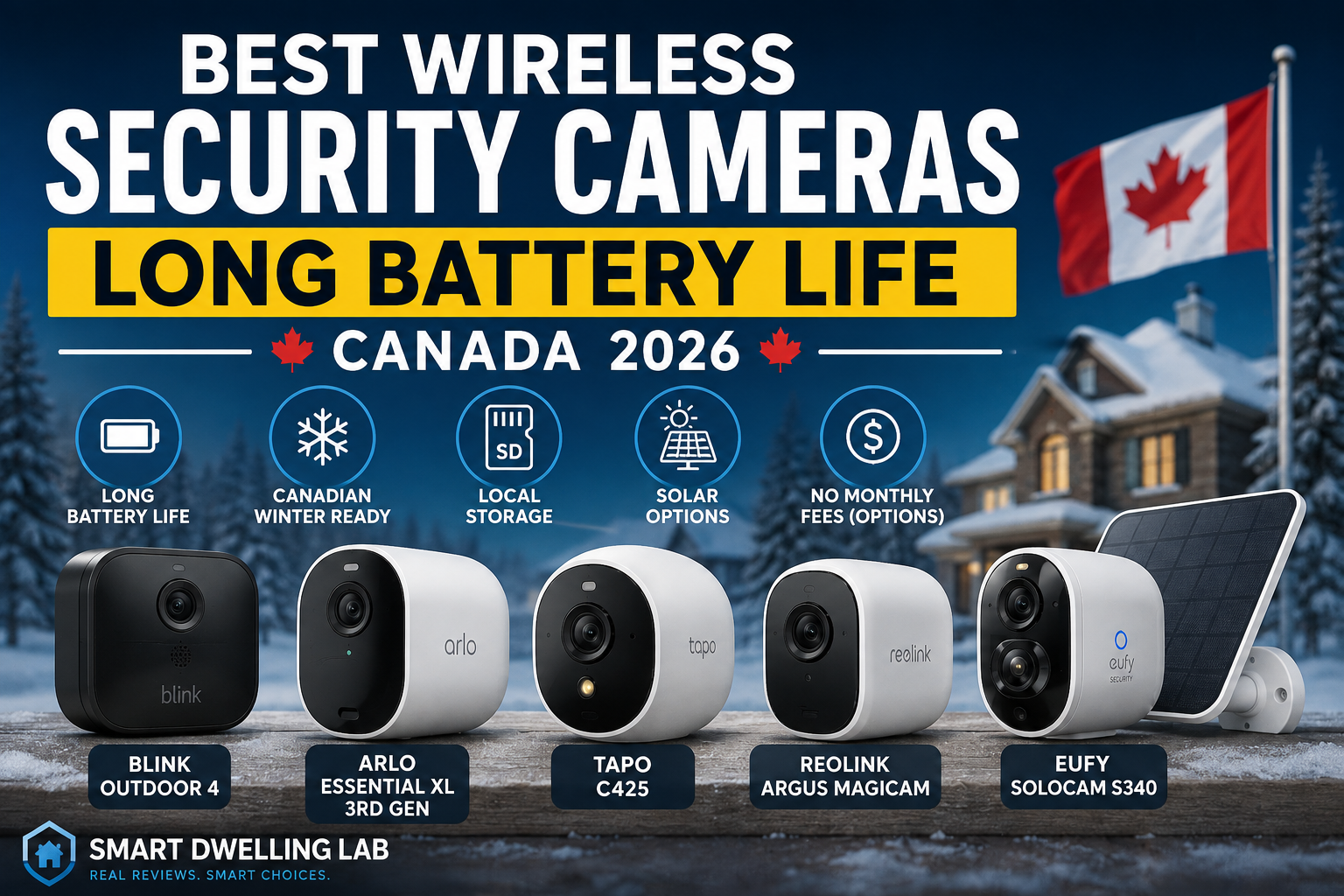
Finding the best wireless security cameras with long battery life in Canada is especially important if you want outdoor protection without climbing a ladder every few weeks to recharge a camera.
Battery life matters everywhere, but Canadian homeowners have an additional challenge: cold weather. A camera advertised to last many months under normal conditions may drain noticeably faster during an Ontario winter, especially when temperatures remain below freezing for long periods. If you are comparing which wireless security cameras have the longest battery life available in Canada, pay particular attention to battery type, cold-weather operating range, motion frequency, and whether solar charging can reduce manual recharging.
For 2026, we compared wireless security cameras available to Canadian buyers with a focus on manufacturer-rated battery life, cold-weather performance, video quality, local storage, subscription requirements, and solar options.
Our top picks range from cameras using replaceable lithium batteries that can last up to two years to rechargeable models designed for more than a year of use and solar-powered cameras that can dramatically reduce manual charging.
Quick Picks: Best Wireless Security Cameras with Long Battery Life in Canada
| Product | Best For | Manufacturer Battery Estimate |
|---|---|---|
| Blink Outdoor 4 | Best Overall Battery Life | Up to 2 years |
| Arlo Essential XL 3rd Gen | Best Rechargeable Battery | Up to 16 months |
| TP-Link Tapo C425 | Best Value | Up to 300 days |
| Reolink Argus MagiCam | Best Replaceable-Battery Option | Up to 9 months |
| eufy SoloCam S340 | Best Solar-Powered Option | Up to 3 months standalone + solar |
Best overall for battery life: Blink Outdoor 4 stands out because its two replaceable AA lithium batteries are rated for up to two years under default settings.
For buyers who prefer a built-in rechargeable battery, the Arlo Essential XL 3rd Gen offers one of the longest manufacturer estimates at up to 16 months.
If you want to minimize charging even further, the eufy SoloCam S340 takes a different approach: its standalone battery rating is shorter, but the included solar panel can continuously replenish power when there is enough sunlight.
Important: Manufacturer battery-life estimates are based on specific test conditions. Actual battery life depends on motion activity, recording duration, live viewing, Wi-Fi strength, settings, temperature, and other environmental factors.
1. Blink Outdoor 4 — Best Overall Battery Life
The Blink Outdoor 4 is our top choice for buyers whose number-one priority is minimizing battery maintenance.
Instead of using a built-in rechargeable battery, the Outdoor 4 runs on two AA lithium batteries, which Blink rates for up to two years of battery life with default settings. That means you do not have to remove the camera and bring it inside to charge it. When the batteries eventually run low, you simply replace them.
For Canadian homeowners, another major advantage is the listed operating range of approximately -20°C to 45°C. That makes the Outdoor 4 more suitable on paper for cold Canadian climates than cameras with minimum operating temperatures around -10°C.
The trade-off is video resolution. Blink Outdoor 4 records in 1080p HD, while several competitors now offer 2K or 3K video. If your main priority is getting maximum detail from faces or objects farther away, there are sharper cameras available.
However, 1080p can still be sufficient for monitoring a front entrance, driveway, shed, side yard, or backyard where extremely detailed zooming is not essential.
Blink also supports motion detection, two-way audio, Alexa integration, and person detection, although some advanced features require a Blink Subscription Plan.
Local storage is possible without a subscription when Outdoor 4 is used with compatible Blink Sync Module hardware and removable storage.
Why We Like It
- Up to two years of battery life under Blink’s default test conditions
- Uses replaceable AA lithium batteries
- No need to remove the camera for recharging
- Rated for temperatures down to approximately -20°C
- IP65 weather resistance
- Two-way audio
- Alexa integration
- Local-storage options available with compatible Sync Module hardware
Things to Consider
- Video resolution is limited to 1080p
- Actual battery life can be much shorter in high-traffic locations
- Person Detection and some premium features require a subscription
- Local storage requires compatible Sync Module hardware and storage media
- Replacing disposable lithium batteries creates an ongoing operating cost
Best for: Homeowners who care more about extremely long battery intervals and simple maintenance than having the highest video resolution.
2. Arlo Essential XL 3rd Gen — Best Rechargeable Battery
If you prefer a rechargeable camera but still want exceptionally long battery life, the Arlo Essential XL Security Camera 2K (3rd Gen) is one of the strongest options available to Canadian buyers.
Arlo rates the XL version for up to 16 months of battery life, significantly longer than the standard Essential model. The large integrated battery makes it particularly attractive for locations that are inconvenient to access regularly.
It records in 2K resolution (2560 × 1440) and includes colour night vision, a built-in spotlight, two-way audio, a siren, and dual-band 2.4GHz and 5GHz Wi-Fi.
The camera’s listed operating range is approximately -20°C to 45°C, making it a better fit for Canadian winter conditions than outdoor cameras with a -10°C minimum rating.
That said, the 16-month figure should not be interpreted as a guarantee. Frequent motion detection, long recording clips, repeated live viewing, poor Wi-Fi signal, and cold temperatures can all reduce real-world battery life.
Arlo also places more emphasis on cloud-based premium features than some competitors. Advanced recording history and smart detection features may require an Arlo Secure subscription.
Why We Like It
- Up to 16 months of manufacturer-rated battery life
- Large rechargeable XL battery
- 2K video
- Colour night vision
- Built-in spotlight and siren
- Two-way audio
- Dual-band Wi-Fi
- Rated down to approximately -20°C
Things to Consider
- Real battery life will depend heavily on camera activity
- Cold weather can reduce rechargeable-battery performance
- Premium cloud recording and smart features may require Arlo Secure
- Larger battery makes the camera more substantial than compact models
- Buyers focused on subscription-free local storage may prefer another brand
Best for: Canadian homeowners who want a rechargeable wireless camera with one of the longest official battery-life ratings available.
3. TP-Link Tapo C425 — Best Value
The TP-Link Tapo C425 offers an excellent balance between long battery life, useful features, good video quality, and price.
Its built-in 10,000mAh rechargeable battery is rated for up to 300 days under TP-Link’s test conditions. That is roughly ten months on paper, which is impressive for a 2K outdoor camera.
The C425 records in 2K QHD (2560 × 1440), provides a wide 142-degree field of view, supports colour night vision, and includes free person, pet, and vehicle detection.
It also supports microSD cards up to 512GB, allowing local recording without requiring a monthly Tapo Care subscription.
For Canada, the camera’s operating temperature specification is another advantage. TP-Link lists an operating range of approximately -20°C to 45°C.
There is, however, an important winter detail: its listed charging temperature is 0°C to 45°C. The camera may continue operating below freezing, but charging the battery during prolonged sub-zero conditions can be limited.
Tapo also supports the optional A202 solar panel. If you choose the C425 Kit that includes solar charging, the amount of manual charging needed during spring, summer, and fall can be dramatically reduced.
In winter, solar performance will depend on available daylight, panel angle, shade, cloud cover, and snow accumulation.
Why We Like It
- Up to 300 days of rated battery life
- Large 10,000mAh rechargeable battery
- 2K QHD video
- Wide 142-degree field of view
- Colour night vision
- Free person, pet, and vehicle detection
- microSD storage up to 512GB
- No monthly subscription required for local recording
- Optional solar charging
- Rated to approximately -20°C for operation
Things to Consider
- Charging specification begins at 0°C
- Actual 300-day battery life requires relatively light usage
- Solar charging becomes less reliable during Canadian winters
- microSD card is sold separately
- Heavy motion traffic can reduce battery life substantially
Best for: Buyers looking for a strong combination of long battery life, 2K video, local storage, and affordability.
4. Reolink Argus MagiCam — Best Replaceable-Battery Option
The Reolink Argus MagiCam takes a different approach from most rechargeable security cameras.
It uses two replaceable AA lithium batteries, with Reolink rating battery life for up to nine months when recording approximately 300 seconds per day.
This makes it attractive if you do not want to wait for an integrated camera battery to recharge. When the batteries run low, you can replace them and put the camera immediately back into service.
The MagiCam is also extremely compact and includes flexible magnetic mounting options, making it useful for entrances, decks, sheds, garages, recreational properties, or locations where you may want to move the camera occasionally.
Video resolution is 1080p, so it does not compete with 2K or 4K cameras for maximum image detail. However, it includes smart person, vehicle, and animal detection, two-way audio, dual-band Wi-Fi, and IP67 weather resistance.
One of its strongest advantages is storage flexibility. It supports microSD cards up to 256GB and can work with the Reolink Home Hub family without requiring monthly fees for basic local recording.
For Canadian winters, there is an important limitation. Reolink lists the operating range at approximately -10°C to 55°C.
That makes it less suitable on paper for fully exposed locations in Ontario or other regions that regularly experience temperatures below -10°C.
Why We Like It
- Up to nine months of rated battery life
- Replaceable AA lithium batteries
- No waiting for the camera to recharge
- Compact design
- Flexible magnetic mounting
- IP67 weather resistance
- Person, vehicle, and animal detection
- microSD storage up to 256GB
- Compatible with Reolink Home Hub
- No monthly fee required for basic local storage
- Dual-band 2.4GHz and 5GHz Wi-Fi
Things to Consider
- Minimum listed operating temperature is only -10°C
- 1080p resolution is lower than many newer competitors
- Requires replacement batteries
- Does not support solar charging
- Nine-month estimate assumes relatively limited daily recording
Best for: Buyers who prefer replaceable batteries and local storage and want a compact camera that can easily be moved between locations.
5. eufy SoloCam S340 — Best Solar-Powered Option
The eufy SoloCam S340 does not have the longest standalone battery rating in this comparison. Instead, its strength is using solar charging to reduce the need for manual charging.
eufy rates the camera for approximately three months of standalone battery life, based on about 300 seconds of recording per day.
The included 2.2W adjustable and removable solar panel can recharge the battery when enough sunlight is available. Under suitable conditions, this can turn a camera with a relatively modest standalone battery estimate into a very low-maintenance system.
The S340 is also much more advanced optically than the typical long-battery camera. It uses dual cameras, including a 3K wide-angle camera and a 2K telephoto camera, and offers 8× hybrid zoom.
Its pan-and-tilt system provides 360-degree horizontal coverage, making it useful for monitoring a large yard or driveway with one unit.
Another advantage is the lack of a mandatory monthly fee. The SoloCam S340 includes 8GB of built-in local storage and on-device human and vehicle detection.
For Canadian climates, eufy lists an operating range of approximately -20°C to 50°C.
Winter sunlight remains the biggest consideration. Solar charging may work extremely well during summer but can be much less effective in December and January due to shorter daylight hours, cloudy skies, shade, and snow.
Why We Like It
- Solar charging included
- Approximately three months of standalone battery life
- 3K wide-angle camera plus 2K telephoto camera
- 8× hybrid zoom
- 360-degree horizontal pan
- Built-in 8GB local storage
- No mandatory monthly fee
- Human and vehicle detection
- Rated down to approximately -20°C
- Solar panel can be mounted separately for better positioning
Things to Consider
- Standalone battery rating is shorter than the other cameras in this guide
- Solar performance varies dramatically by season
- Snow can block the solar panel
- Requires careful panel placement
- 2.4GHz Wi-Fi only
- Built-in battery is not replaceable
Best for: Homeowners who want minimum charging maintenance and have a mounting location that receives dependable sunlight.
Battery-Life Comparison
The manufacturer’s advertised numbers make it easy to assume that one camera is automatically better than another. In practice, those figures should be treated as a comparison starting point rather than guaranteed real-world performance.
Manufacturer Battery Estimates
Blink Outdoor 4: Up to 2 years
Arlo Essential XL 3rd Gen: Up to 16 months
Tapo C425: Up to 300 days
Reolink Argus MagiCam: Up to 9 months
eufy SoloCam S340: Approximately 3 months standalone, with solar charging designed to extend operation
These numbers are not directly comparable under identical conditions because each manufacturer uses its own test methodology.
For example, a camera facing a quiet backyard may record very little each day, while the exact same model facing a busy sidewalk could activate hundreds of times.
What Actually Drains a Wireless Security Camera Battery?
Several factors have a much larger effect on battery life than many buyers expect.
1. Motion Activity
Every detection event uses power.
A camera facing a busy road, sidewalk, moving tree, or neighbour’s driveway may trigger far more often than one monitoring a quiet backyard.
Using activity zones and adjusting motion sensitivity can significantly improve battery life.
2. Recording Length
A camera recording 10-second motion clips uses considerably less energy than one recording long clips every time motion occurs.
More recording means more processor activity, more storage writes, and more wireless transmission.
3. Live Viewing
Repeatedly opening the camera’s live feed from your phone uses battery power.
If several family members frequently check the same camera throughout the day, battery life can be substantially shorter than the manufacturer’s estimate.
4. Wi-Fi Signal Strength
Weak Wi-Fi can force the camera to work harder to maintain a connection.
For cameras mounted on detached garages, sheds, or the far side of a house, improving Wi-Fi coverage may help both reliability and battery performance.
5. Cold Weather
Cold temperatures are particularly important for Canadian homeowners.
Lithium batteries generally deliver less usable capacity when cold. A battery camera that lasts many months during summer may require noticeably more maintenance in January.
How Does Canadian Winter Affect Security Camera Battery Life?
Canadian winter is probably the biggest reason not to rely exclusively on advertised battery-life numbers.
The official operating ranges in this comparison are:
- Blink Outdoor 4: approximately -20°C to 45°C
- Arlo Essential XL 3rd Gen: approximately -20°C to 45°C
- Tapo C425: approximately -20°C to 45°C
- Reolink Argus MagiCam: approximately -10°C to 55°C
- eufy SoloCam S340: approximately -20°C to 50°C
An operating-temperature rating means the manufacturer designed the camera to operate within that range. It does not mean the battery will perform exactly the same at -20°C as it does at 20°C.
Expect battery endurance to decline during long cold periods.
Best Picks for Canadian Winter
Best replaceable-battery winter option: Blink Outdoor 4
Its lithium AA batteries are easy to replace, and the camera is rated down to approximately -20°C.
Best rechargeable winter option: Arlo Essential XL 3rd Gen
Its large battery and -20°C operating specification make it one of the stronger rechargeable choices.
Best budget option: Tapo C425
The camera operates down to -20°C, although its battery charging temperature starts at 0°C.
Best solar option: eufy SoloCam S340
The camera itself is rated down to -20°C, but winter solar availability must be considered.
Use more caution in extreme cold: Reolink Argus MagiCam
Its -10°C minimum operating specification makes it better suited to milder areas or more sheltered locations.
Replaceable vs. Rechargeable Batteries
There are two main philosophies for battery-powered security cameras.
Replaceable Batteries
Models such as Blink Outdoor 4 and Reolink Argus MagiCam let you remove depleted batteries and replace them immediately.
Advantages:
- Minimal camera downtime
- No waiting for charging
- Easy to keep spare batteries
- Useful for hard-to-reach locations
Disadvantages:
- Ongoing battery cost
- More battery waste
- Must use the correct battery type
Rechargeable Batteries
Arlo, Tapo, and eufy use integrated rechargeable batteries.
Advantages:
- No need to continually buy disposable batteries
- Can be combined with solar panels on certain models
- Lower long-term battery-replacement cost
Disadvantages:
- Camera may need to be removed for charging
- Charging can be difficult in extreme cold
- Integrated batteries eventually degrade
Is Solar Power Worth It in Canada?
Yes — but with realistic expectations.
A well-positioned solar panel can dramatically reduce manual charging from spring through fall.
During Canadian winter, however, several factors work against solar charging:
- Shorter daylight hours
- Lower sun angle
- Cloudy weather
- Snow accumulation
- Nearby buildings and trees creating shade
For Ontario homeowners, a south-facing location with good exposure is preferable.
The eufy SoloCam S340 includes a solar panel, while the Tapo C425 can be paired with a compatible Tapo solar panel.
Solar should be viewed as a tool for extending battery life, not as an absolute guarantee that a camera will never require manual charging.
Do Long-Battery Security Cameras Require a Subscription?
Not necessarily.
Blink Outdoor 4
Blink offers optional subscription plans for cloud storage and premium features. Local storage can be used with compatible Sync Module hardware and removable storage.
Arlo Essential XL
Arlo’s premium cloud recording and advanced smart features are tied closely to Arlo Secure plans. Buyers who dislike recurring fees should factor this into the purchase decision.
Tapo C425
Supports microSD local recording up to 512GB, allowing basic recording without a Tapo Care subscription.
Reolink Argus MagiCam
Supports microSD local storage up to 256GB and Reolink Home Hub options without requiring a monthly fee for basic local recording.
eufy SoloCam S340
Includes 8GB of built-in local storage and on-device AI, with no mandatory monthly subscription for core local features.
How to Maximize Security Camera Battery Life
Reduce Unnecessary Motion Alerts
Use activity zones to exclude busy streets, sidewalks, trees, or neighbouring properties.
Shorten Recording Duration
Long motion clips consume significantly more power.
Improve Wi-Fi Coverage
A stronger network connection can reduce connection problems and unnecessary battery consumption.
Avoid Excessive Live Viewing
Use Live View when necessary rather than leaving it open for extended periods.
Adjust Detection Sensitivity
Very high sensitivity can create unnecessary activations from shadows, branches, animals, or distant movement.
Optimize Solar Panel Placement
Keep solar panels clean and free of snow and position them for maximum available winter sunlight.
Consider Camera Location
A camera under an eave or other partially sheltered location may be exposed to less wind, snow, and ice than a fully exposed mounting position.
Frequently Asked Questions
Which wireless security camera has the longest battery life?
Among the cameras in this comparison, Blink Outdoor 4 has the longest manufacturer-rated battery life at up to two years using two AA lithium batteries under default settings.
What is the best rechargeable security camera for long battery life?
The Arlo Essential XL 3rd Gen stands out with an advertised battery life of up to 16 months.
What is the best long-battery security camera without a subscription?
The Tapo C425 and Reolink Argus MagiCam are especially attractive because they support local microSD recording without requiring a monthly subscription for basic storage.
The eufy SoloCam S340 also provides built-in local storage without a mandatory monthly plan.
Do battery security cameras work at -20°C?
Some do. Blink Outdoor 4, Arlo Essential XL 3rd Gen, Tapo C425, and eufy SoloCam S340 all have listed minimum operating temperatures around -20°C.
Battery capacity may still decline substantially during prolonged cold conditions.
How often will I really need to charge a wireless camera?
There is no universal answer.
A camera in a low-traffic backyard could operate for many months, while the same camera facing a busy driveway or sidewalk could require substantially more frequent charging.
Choosing wireless security cameras with long battery life can reduce charging frequency, but actual results still depend on motion activity, temperature, Wi-Fi strength, and recording settings.
Is Blink’s two-year battery claim realistic?
Blink specifies up to two years under default settings. Actual battery life depends on camera activity, settings, environmental conditions, and usage.
Treat the figure as a best-case manufacturer estimate rather than a guarantee.
Are replaceable batteries better than rechargeable batteries in Canada?
They can be convenient because you can immediately swap depleted batteries rather than waiting for charging.
Rechargeable systems can be less expensive to operate over time and may support solar charging.
The better choice depends on your installation and maintenance preferences.
Can solar cameras work during an Ontario winter?
Yes, but they generally collect less energy in winter. Short days, cloud cover, snow, and shade can all reduce charging performance.
A sunny south-facing installation provides the best chance of maintaining useful solar charging through winter.
Final Verdict
When comparing wireless security cameras with long battery life, Canadian homeowners should consider winter performance as well as the advertised battery estimate.
For Canadian homeowners focused primarily on battery life, the Blink Outdoor 4 is our top pick because of its up to two-year battery rating, replaceable lithium batteries, and approximately -20°C minimum operating temperature.
If you prefer a rechargeable system, the Arlo Essential XL 3rd Gen stands out with up to 16 months of advertised battery life and sharper 2K video.
The TP-Link Tapo C425 provides the best overall value, combining up to 300 days of rated battery life, 2K video, local storage, free AI detection, and optional solar charging.
The Reolink Argus MagiCam is a practical option for buyers who like replaceable batteries and subscription-free local storage, although its -10°C minimum operating specification makes it less ideal for exposed locations during severe Canadian winters.
Finally, the eufy SoloCam S340 is our preferred solar option. Its standalone battery rating is shorter, but the included solar panel, advanced dual-camera system, built-in local storage, and -20°C operating specification make it an attractive low-maintenance choice for sunny locations.
The key is not to choose a camera based on the largest advertised battery number alone. For Canadian homes, cold-weather rating, motion activity, charging method, solar exposure, local storage, and subscription costs all affect how convenient a wireless security camera will be over the long term.
For a broader comparison that prioritizes video quality, coverage, storage, and overall security performance rather than battery life alone, see our guide to Best Outdoor Security Cameras in Canada (2026).